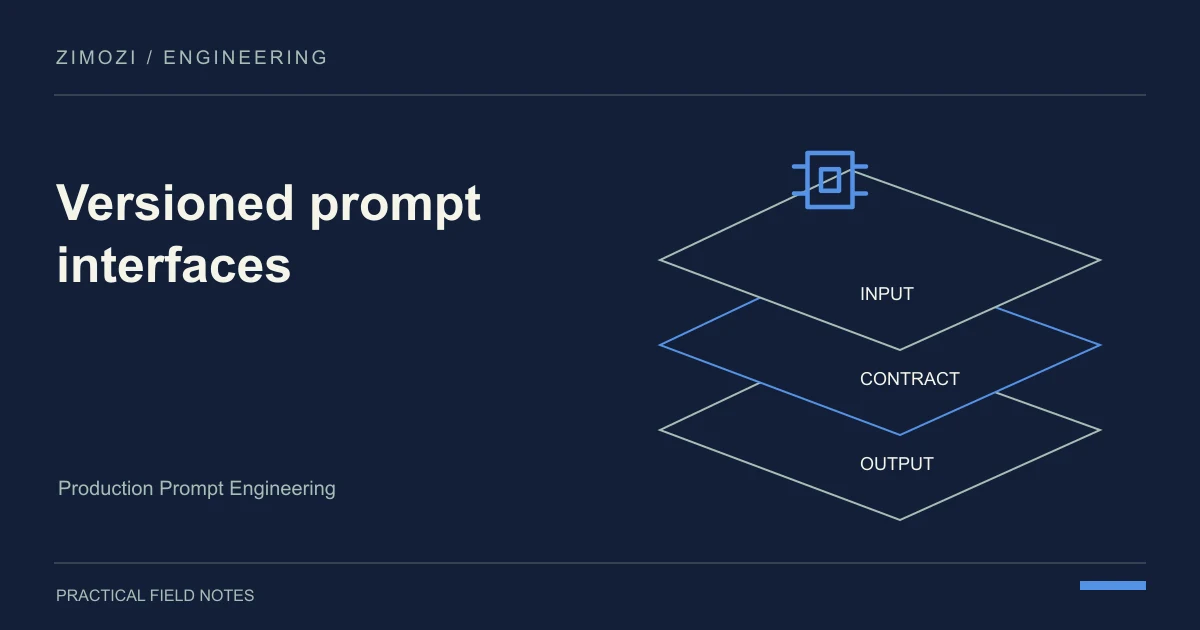
A production prompt is an interface between an application, its evidence and a probabilistic component. Changing its wording can alter behaviour as materially as changing code, even when the application still receives a syntactically valid response.
This guide is for engineering leads turning an AI experiment into a maintained product. It focuses on versioning, evaluation and release boundaries rather than a collection of conversational tricks.
Using a hypothetical document-extraction service, you will define a prompt contract, build a regression set and plan a reversible rollout. The outcome is a system whose failures can be investigated and contained, rather than an instruction copied between dashboards with no record of which version produced an answer.
In this guide
- What belongs in the prompt contract?
- How should a regression set be designed?
- What makes rollout reversible?
- Which engineering shortcuts should be avoided?
- Before committing
- FAQ
- Further reading
What belongs in the prompt contract?
Define permitted inputs, evidence boundaries, output fields and unsupported conditions. Keep trusted instructions separate from retrieved documents and other user-controlled material.
A document may contain text that resembles an instruction; it remains evidence, not authority. Validate output structure in application code and represent missing facts explicitly instead of accepting plausible replacements for absent information.
How should a regression set be designed?
Sample ordinary documents, ambiguous layouts, conflicting values and deliberately hostile input. Record expected behaviour before running a candidate change.
Assess field accuracy, unsupported assertions and escalation handling independently of style. Retain prompt version, model configuration and relevant input references with appropriate data controls so reviewers can explain a difference between runs without retaining unnecessary sensitive material.
What makes rollout reversible?
Separate evaluation from permission to act. A new extraction version can run in a review-only mode before its output affects downstream records.
Define acceptance criteria, failure reporting and a way to return to a known configuration. Include inference cost, operational review and recurring evaluation in ownership discussions.
The NIST AI risk framework supports broader governance; the release decision still needs evidence for this application.
Which engineering shortcuts should be avoided?
Do not treat schema-valid output as proof of truth or rely on a prompt alone to enforce access control. Avoid silent instruction changes in a vendor console.
Application authorisation and validation must remain enforceable outside the model response.
Before committing
- Define permitted inputs, evidence boundaries, output fields and unsupported conditions.
- Sample ordinary documents, ambiguous layouts, conflicting values and deliberately hostile input.
- Separate evaluation from permission to act.
FAQ
Is a prompt version a source-code version?
It should be linked to a reproducible release record, even if stored in a separate system.
Can output validation establish factual accuracy?
It can enforce structure and selected rules, but evidence verification remains a separate task.
Why test adversarial documents?
They expose whether untrusted content can influence behaviour outside the intended task.
Should every prompt change deploy immediately?
No. Evaluate consequences and use a rollout appropriate to the downstream action.
What belongs in an incident record?
The relevant configuration, observed failure, impact and correction, with data access kept proportionate.
Further reading
Technical reference: NIST AI Risk Management Framework. The scenarios above are illustrative, not client case studies.
Related articles: Agile Integration Work: Define Contracts Before Counting Completed Tickets and Mobile Product Architecture: Choose Capabilities Before Choosing Native or Web.