Scaling Your Engineering Team: Dedicated Developers vs. Staff Augmentation for US & Global Tech Companies
Dedicated developers or staff augmentation? Compare cost, management and timezone overlap to scale your team in the USA and worldwide.
If you need to scale your team fast, you can hire developers in-house, use staff augmentation, or bring in dedicated developers. For engineering VPs, CTOs and founders, the choice affects cost, management time and how much project knowledge stays inside your company.
This guide compares team augmentation with a dedicated team in plain terms. It covers what in-house hiring costs in the USA, and how dedicated developers work across time zones for US and global tech companies.
What is staff augmentation?
Staff augmentation, sometimes called team augmentation, is a form of outsourcing where you add individual contractors to your existing engineering team to fill a specific skill gap. You manage their daily tasks directly, the same way you would manage your own employees. It works well for short-term needs, such as covering a colleague on leave or bringing in a specialist for a single feature.
For example, if a project needs an extra backend developer for three months, staff augmentation gives you quick help. The trade-off is management time. Your technical leaders have to assign tasks, review the work and give constant direction. Augmented staff are also temporary, so the project knowledge they build leaves with them when their contract ends.
What are dedicated developers?
Dedicated developers work as a stable, pre-vetted group that takes ownership of a specific product area. Instead of supplying individual workers, the vendor provides a complete dedicated team that often includes developers, testers and a technical lead. The vendor handles the administrative side, so the team can focus on your business goals.
This model suits long-term work, especially projects that run for more than six months. As the team stays together, they learn your software architecture and your business domain. That shared knowledge helps them work faster over time. Rather than adding to your management load, a dedicated team takes much of it on.
The real cost of hiring developers in-house in the US
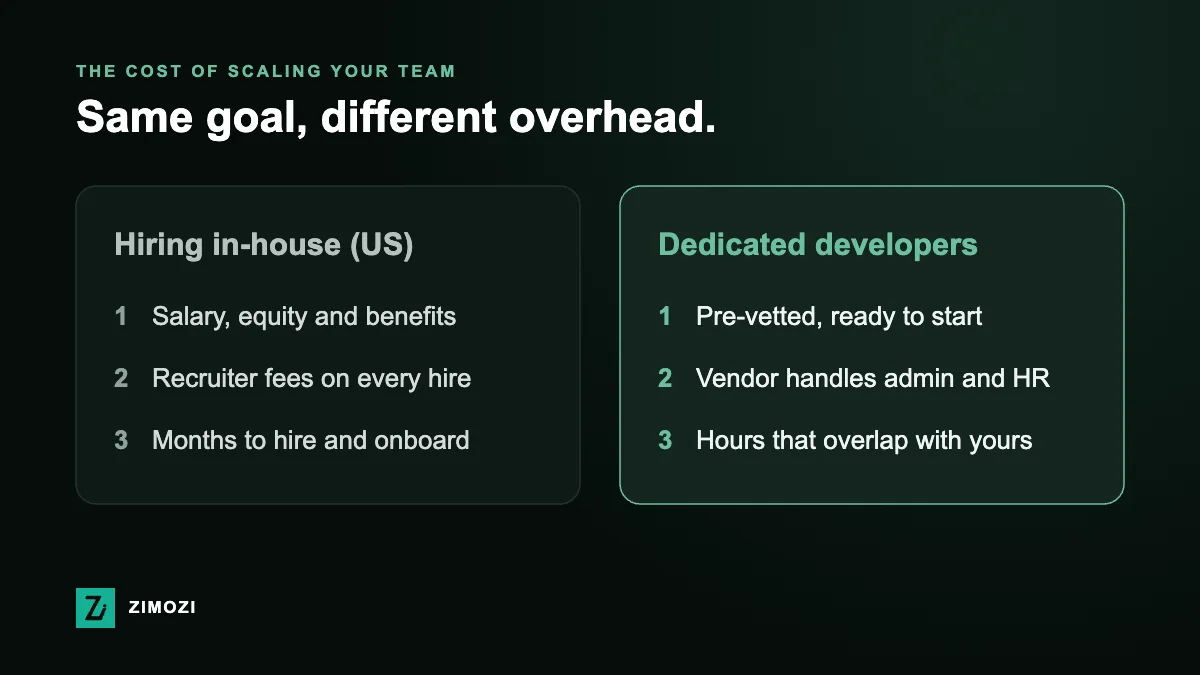
Hiring in-house feels simple until you add up the cost. Senior software engineers in the USA can often command salaries of $200,000 or more. On top of salary come equity, benefits, payroll taxes and recruiter fees, plus the months it can take to find, hire and onboard the right person.
Those costs also stay fixed. If priorities change or the project ends, you still carry them. That is why many companies that want to scale your team quickly look beyond a purely in-house model.
How dedicated developers reduce hiring overhead
A dedicated team removes much of that overhead, because you are not building a hiring pipeline from scratch. Here is where the difference shows up:
- Pre-vetted engineers: the vendor has already screened the developers, so you skip the long search and interview cycle.
- Faster start: a ready team can begin work in weeks rather than after months of recruiting.
- Less admin: the vendor handles payroll, equipment and HR, so your leaders stay focused on the product.
- Flexible scale: you can grow or reduce the team as the roadmap changes, without redundancy costs.
For US and global companies, timezone overlap matters as much as location. A well-run dedicated team agrees working hours that overlap with your core hours, so standups, code reviews and releases happen in real time rather than a day later.
Dedicated developers vs staff augmentation: the key differences
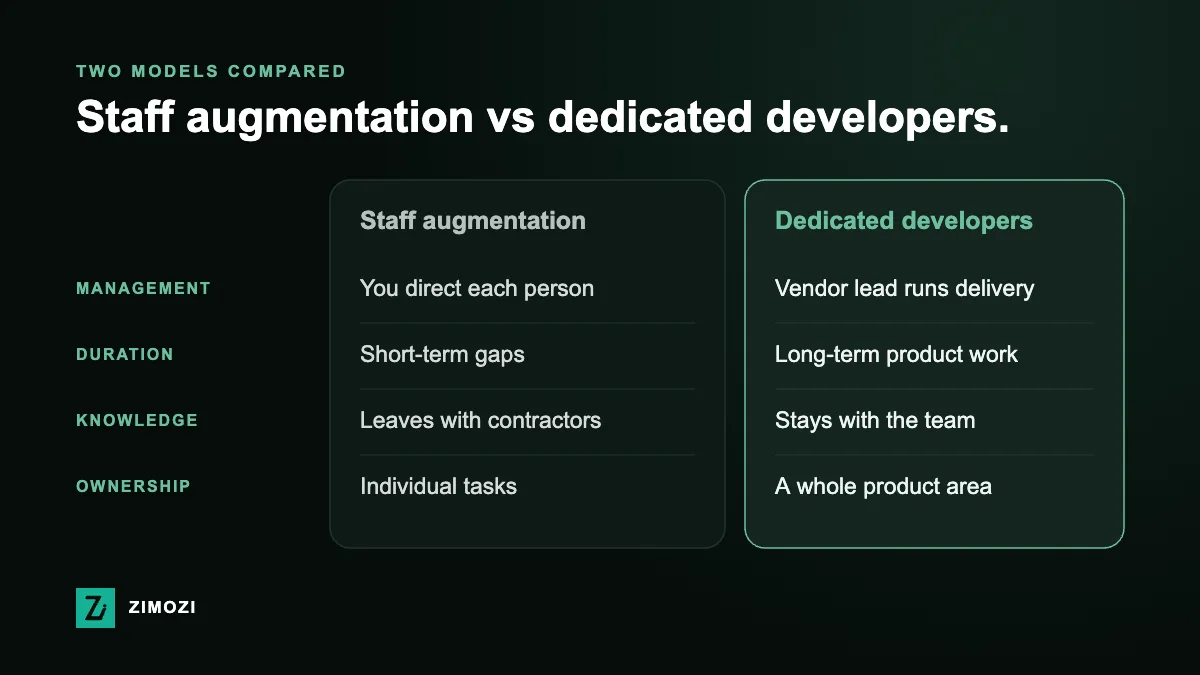
- Management: with staff augmentation, your leaders direct each contractor. With dedicated developers, the vendor’s technical lead manages delivery.
- Duration: staff augmentation fits short-term gaps. A dedicated team fits long-term product work.
- Knowledge retention: augmented staff take their knowledge with them. A dedicated team keeps it and builds on it.
- Ownership: individual contractors complete tasks. A dedicated team owns the delivery of a product area.
- Flexibility: staff augmentation is easy to scale up and stop. A dedicated team needs a longer initial commitment.
How much does a dedicated development team cost?
How much a dedicated team costs depends on team size, seniority mix, tech stack, project length and whether testers and a technical lead are included. There is no single price, so ask each vendor for a scope-based estimate instead of a flat rate.
When you compare options, look at the full in-house cost, not just salary. Include recruiter fees, benefits, equipment and the time it takes to hire. That gives you a fair picture of the cost of each route.
How to choose the right model
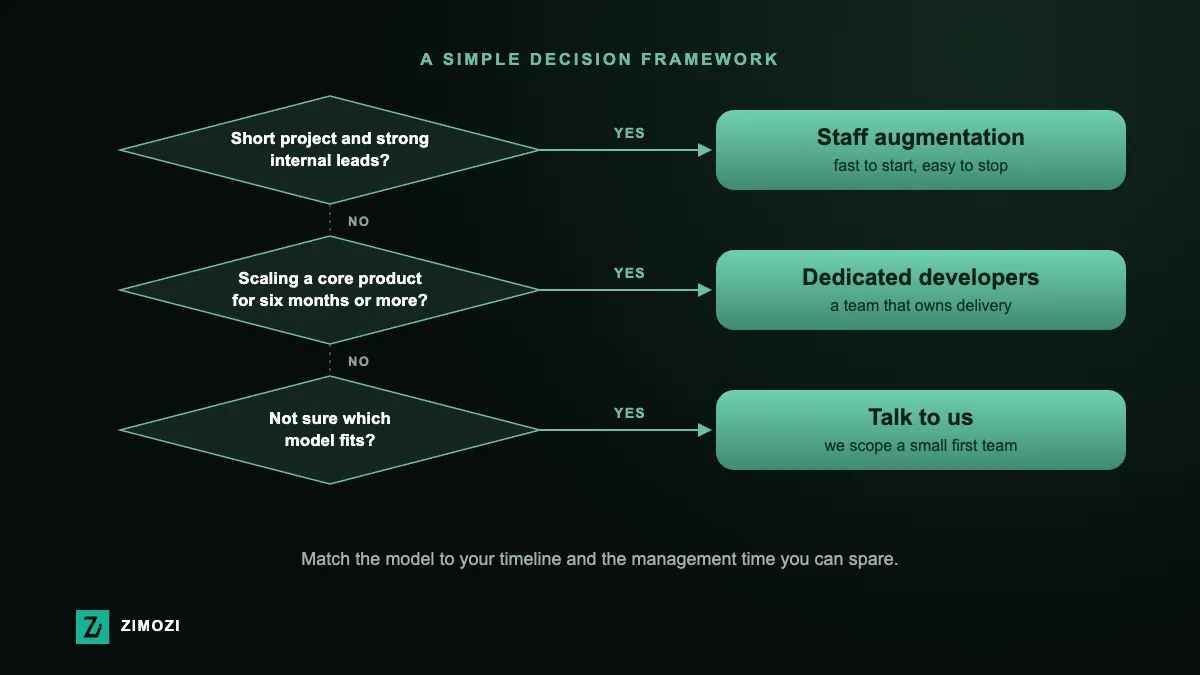
The right choice depends on two things: how long the project will run, and how much management capacity you have in-house.
Choose staff augmentation if you have a short-term project and strong internal leaders with time to manage external engineers. It lets you scale up quickly and end the contract when the work is done.
Choose dedicated developers if you are scaling a core product and want a group to take ownership of delivery. The commitment is longer, but it asks less of your internal staff day to day and keeps critical project knowledge close. It also suits companies that expect the roadmap to keep changing. If you are still deciding how to approach a new build, our post on choosing between an AI product studio and a traditional dev shop covers a related question.
Where dedicated developers add the most value
Dedicated teams tend to pay off on work that is complex and continues to evolve. A few common examples:
- Custom web development for platforms that need to grow with your customers.
- Mobile app development across iOS, Android and cross-platform builds.
- Fintech and SaaS product development, where security and compliance need steady attention. Our guide to multi-tenant SaaS architecture shows why early technical decisions matter here.
- AI and workflow automation, including agent-based systems like those in our multi-agent playbook.
- DevOps and cloud work, such as automated releases and reliable infrastructure.
Building with Zimozi
At Zimozi, we help tech companies scale their engineering capability. We work with businesses on custom web and mobile applications, SaaS product development and system integrations. You can see the full range on our services page, and examples of delivered work in our projects.
When a company needs to expand, we can provide dedicated developers as a dedicated team to handle complex builds. Whether you need a secure platform for fintech and digital product development, or want to add AI agents and workflow automation to your operations, we build teams around your long-term goals. Our focus is on stable engineering units that understand your core business.
Final thoughts
Adding external engineers is a practical way to scale software development. Staff augmentation gives you quick technical skills for immediate gaps. Dedicated developers give you long-term stability and product ownership, without the overhead of hiring in-house. The better fit is the one that matches your timeline and the management time you can spare.
If you are considering a similar approach, Zimozi can help define a small first version and assess the technical requirements. Would you like to discuss the idea?