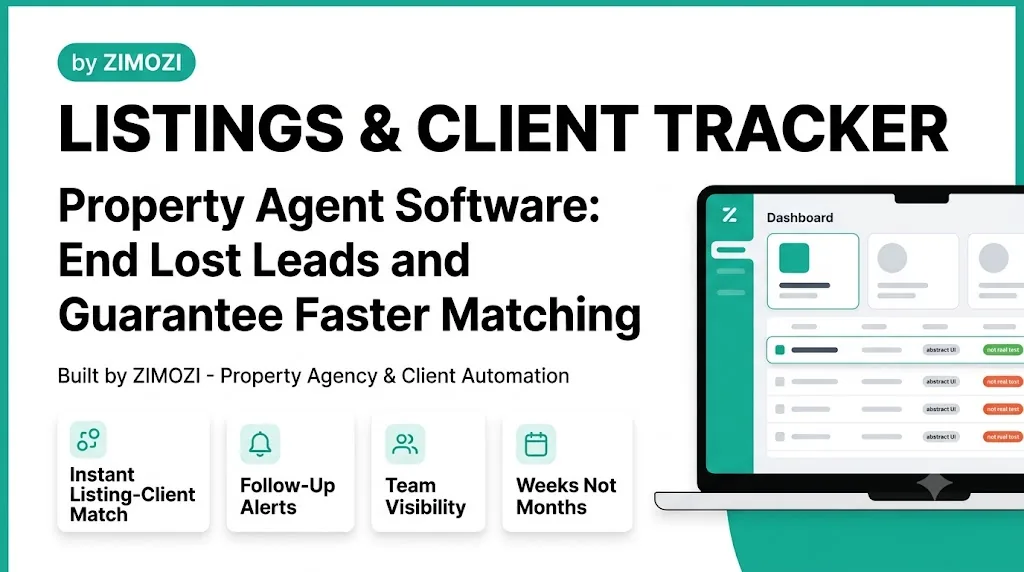
In today’s competitive real estate market, speed and responsiveness determine which agent secures the client. Using a dedicated Listings and Client Tracker, boutique agencies can ensure prospective buyers and tenants secure immediate viewing appointments before competitors reply.
Yet within many small and boutique real estate firms worldwide, valuable client inquiries and property details remain scattered across messaging apps, shared spreadsheets, and personal memory. When an interested buyer or tenant calls about a newly marketed property, agents often cannot remember which existing clients asked for identical units the previous week. Without a centralized tracking system, by the time an agent searches through disparate chat threads and spreadsheets to piece together the details, the lead has already moved on to a competitor who responded immediately.
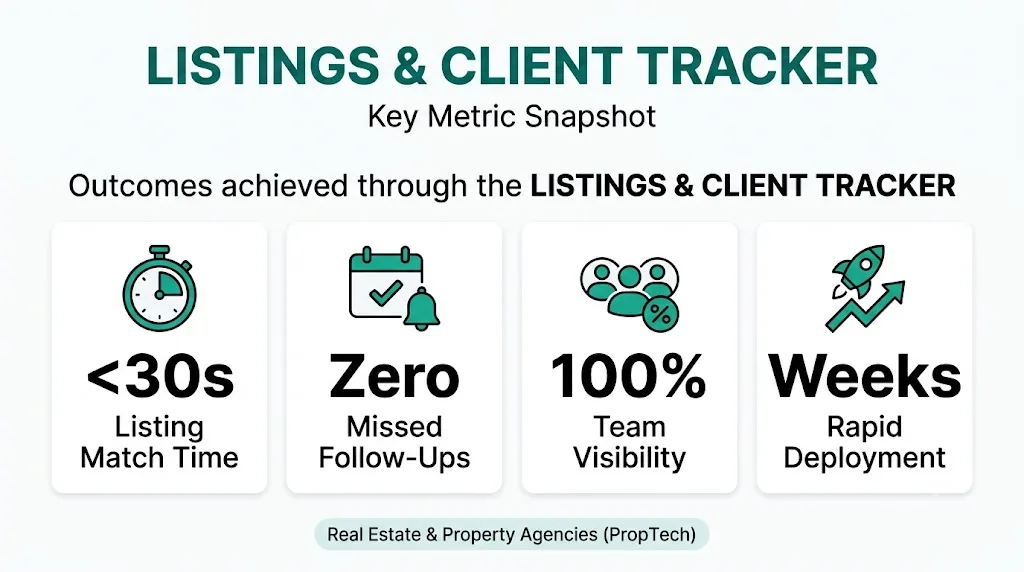
The Listings and Client Tracker developed by Zimozi provides a centralized web platform designed specifically for independent property teams and boutique brokerages. By directly connecting active property listings, client briefs, and upcoming follow-ups into a unified workspace, it enables agents to match properties to qualified clients in under 30 seconds.
Why Real Estate Tracking Breaks Down Without a Client Tracker
Managing property viewings and client briefs through informal spreadsheets and mobile chat apps works adequately for a solo agent carrying fewer than ten listings. Once an agent manages 15 active listings and 30 active clients, matching properties to buyers purely by memory becomes cognitively overwhelming.
Operating without an integrated Listings and Client Tracker leads to recurring operational failures across the agency:
- Missed viewing windows: Inquiries go unanswered while agents search through disjointed notes, conceding fast-moving deals to quicker competitors.
- High-value leads going cold: Follow-ups get buried inside crowded messaging apps instead of being surfaced when due, risking thousands of dollars in lost commission on single transactions.
- Suboptimal inventory matching: Because static spreadsheets cannot dynamically match client requirements to listings, agents show whatever inventory they remember rather than the properties that actually fit the brief.
- Duplicate agency contact: Team members lack visibility into what colleagues showed yesterday, resulting in duplicate viewings or multiple agents from the same firm contacting the same lead about the same property.
- Zero pipeline visibility for agency owners: Principal brokers and team leaders cannot gauge monthly closing potential without personally interrogating each agent, because no shared deal pipeline exists.
This administrative gap affects the majority of the global real estate sector, where boutique brokerages and independent teams with 1 to 10 agents dominate local markets. These compact teams are too lean for complex, cumbersome enterprise systems, yet too busy to rely on static spreadsheets that fail to prompt timely follow-ups.
This administrative gap affects the majority of the global real estate sector, where boutique brokerages and independent teams with 1 to 10 agents dominate local markets. According to research from the National Association of Realtors, the vast majority of real estate firms operate as single-office boutique outfits with a median of two to three agents. These compact teams are too lean for complex, cumbersome enterprise systems, yet too busy to rely on static spreadsheets that fail to prompt timely follow-ups.
Core Capabilities of the Listings and Client Tracker
Instead of overwhelming agents with unnecessary software modules, the platform focuses strictly on the operational link connecting properties, buyers, and immediate next steps:
| Core Operational Feature | Real Estate Agency Impact |
| Centralized Listings Register | Catalogs properties with addresses, property types, sale or rental terms, pricing, and live statuses from Available through Closed. |
| Comprehensive Client Register | Records prospective buyer and tenant profiles with budgets, preferred neighborhoods, move-in timelines, lead sources, and active statuses. |
| Deal Pipeline Board | Links qualified clients directly to specific property listings, tracking progress across each negotiation stage. |
| Next Action Tracking | Surfaces overdue follow-ups and today’s scheduled viewings directly on the dashboard to keep deals moving. |
| Bidirectional Matching | Enables agents to navigate instantly from a client profile to matching listings, or from a listing to all clients who viewed it. |
The Daily Operational Workflow for Boutique Real Estate Teams
The Daily Workflow Using the Listings and Client Tracker provides agents and agency owners with a structured, repeatable daily routine:
- Review Today’s Dashboard: The agent opens the dashboard each morning to check scheduled property viewings and review overdue follow-up tasks flagged by the Next Action engine.
- Log Inbound Client Requirements: When a new buyer or tenant reaches out, staff capture contact details, target budget, preferred locations, and timelines directly into the client register.
- Execute Instant Property Matching: Agents filter active inventory against the client’s criteria, pulling up viable listings immediately while the client is still on the phone.
- Log Property Viewings: As viewings are arranged, the deal pipeline links the prospective client to the property, giving all agents in the office full visibility over scheduled appointments.
- Set Definite Next Actions: Following every viewing, the agent logs client feedback and schedules a timestamped follow-up action so warm leads never slip through the cracks.
- Monitor Agency Pipeline Health: Agency leaders review active deals across the entire team in one unified pipeline view, tracking progress toward revenue goals without manual check-ins.
Why Lean Operational Tools Outperform Enterprise Real Estate CRMs
Large enterprise customer relationship management platforms are frequently built for major real estate franchises with dedicated IT departments. As highlighted in research on sales pipeline adoption by Harvard Business Review, complex CRM architectures often see high abandonment rates among frontline sales staff when administrative burden outweighs daily utility. Boutique agencies with 1 to 10 agents often abandon these platforms because they are expensive, complicated to set up, and cluttered with features that slow down frontline dealmaking.
The Listings and Client Tracker is designed specifically around fast property matching and actionable follow-ups. To preserve speed and ease of use, non-essential enterprise overhead is deliberately excluded from the core version:
- No native mobile app installation requirements.
- No complex commission splits or internal accounting ledgers.
- No fragmented third-party portal API maintenance dependencies.
- No rigid document generation suites or complex contract management modules.
- No bloated marketing automation suites that require dedicated administration.
By focusing strictly on matching properties to buyers and highlighting immediate next actions, the Listings and Client Tracker delivers an intuitive operating system that agents can adopt on day one without technical training.
Frequently Asked Questions (FAQ)
What is the Listings and Client Tracker?
The Listings and Client Tracker is a web-based operational tool developed by Zimozi that gives boutique property agencies and independent teams a single workspace to organize property listings, manage buyer and tenant requirements, and track daily follow-up actions.
How does the tool help agents respond faster to prospective clients?
The platform connects listings directly to client preferences, allowing agents to search criteria and identify matching units in under 30 seconds while the caller is still on the line.
Why are spreadsheets inefficient for matching property clients to listings?
Spreadsheets do not provide automated alerts for overdue follow-ups, cannot link client criteria to available inventory dynamically, and fail to prevent team members from contacting the same lead about identical properties.
Who is this property management tool designed for?
The platform is built specifically for small to mid-sized real estate teams with 1 to 10 agents, including boutique residential agencies, independent team leads within larger brokerage networks, and commercial or industrial property teams.
Does the system handle commission disbursements or advertising portal syndication?
No. The core version concentrates exclusively on the operational matching loop—tracking property listings, client requirements, pipeline stages, and follow-up deadlines—without complex commission accounting, portal integrations, or document-signing overhead.