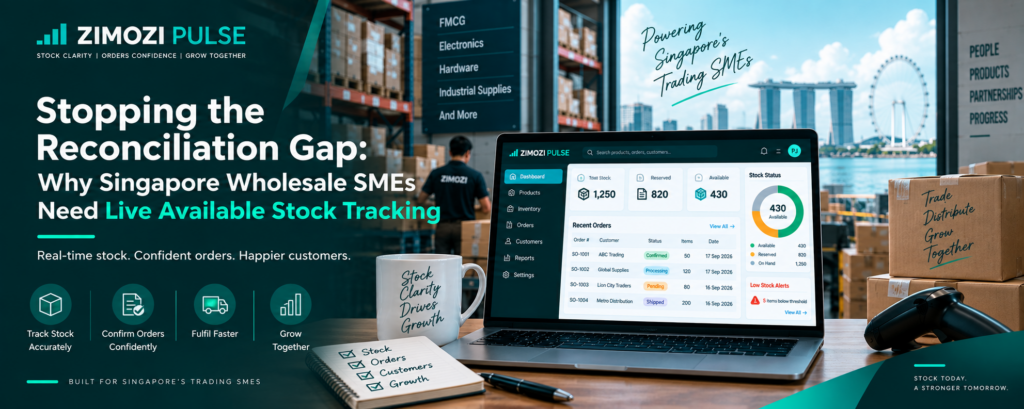
Real-time available stock tracking has become vital in modern B2B commerce, where trading and wholesale operations move at a breakneck pace. Whether distributing FMCG, hardware, electronics, or industrial supplies, success relies on fast customer confirmations and dependable fulfillment.
Yet, many trading small and medium enterprises (SMEs) run critical sales and inventory loops across fragmented channels. On-hand quantities sit in one spreadsheet, open customer orders live in another, incoming requests arrive via WhatsApp or email, and fulfillment notes exist on paper.
This disconnected workflow produces a dangerous reconciliation gap. Staff mistake physical inventory for sellable stock, leading to accidental overselling, fulfillment delays, and eroded customer trust. According to research on supply chain volatility by Gartner, organizations that lack synchronized inventory visibility suffer direct hits to order fill rates and brand loyalty.
Zimozi Pulse closes this blind spot by providing a unified stock and order tracking system engineered specifically for agile trading and wholesale SMEs.
The True Cost of Missing Available Stock Tracking
The central problem in wholesale operations is rarely counting boxes on warehouse shelves. The true challenge is knowing real available stock after accounting for outstanding customer commitments.
Consider a common scenario:
- A warehouse spreadsheet records 100 units on hand.
- Open sales orders already commit 70 of those units to existing buyers.
- Only 30 units are truly free to sell.
Without a single operational view connecting stock with demand, sales staff treat “100 on hand” as “100 available.” By the time dispatch teams notice the shortage, the business has already over-promised to multiple valued clients.
| Operational Area | Traditional Fragmented Approach | Zimozi Pulse Operational View |
| Availability Calculation | Manual cross-checking across sheets and chats | Calculated instantly: Physical Stock minus Reserved Stock |
| Order Confirmation | Sales reps confirm orders on assumed stock | Immediate visibility into real-time fulfillment capacity |
| Inventory Updates | Delayed batch updates at the end of the day | Synchronized deductions upon order reservation and dispatch |
| Shortage Detection | Discovered late during picking and packing | Proactive alerts highlighting low stock and allocation risks |
| Team Alignment | Disjointed handoffs between sales and ops teams | Shared, transparent truth across the entire workspace |
Relying on manual reconciliation turns routine sales confirmations into unnecessary operational risks.
How Zimozi Pulse Automates Available Stock Tracking
Zimozi Pulse replaces the unofficial operating system of fragile spreadsheets and fragmented chat groups with a focused, real-time command workspace.ith a focused, real-time command workspace.

The platform standardizes five key steps of the wholesale workflow:
- Centralize Catalog and Inventory: Track total physical counts alongside calculated reserved and available stock figures, complete with customizable low-stock alert thresholds.
- Instant Order Feasibility: Log new customer orders and immediately verify whether current uncommitted stock can fulfill the request before making commitments.
- Automated Stock Reservation: When an order is confirmed, the system immediately reserves those units. The items cannot be sold twice, preventing accidental double-allocations.
- Synchronized Fulfillment: Once dispatch teams fulfill and ship an order, physical and reserved numbers update together, keeping inventory balance accurate without manual formula adjustments.
- Proactive Priority Dashboards: Surface fulfillment backlogs, pending dispatches, and low-stock warnings directly where daily work begins.
By eliminating enterprise clutter, the system focuses strictly on stock clarity, customer orders, and prompt fulfillment.
Why Available Stock Tracking Powers Wholesale Growth
Modern supply chain pressures urge wholesale enterprises worldwide to build agile, resilient operations. However, full-scale enterprise resource planning (ERP) platforms or heavyweight warehouse management systems (WMS) often bring months of painful onboarding, steep subscription tiers, and features that small teams never touch.
Zimozi Pulse bypasses this bloat. It excludes complicated accounting ledgers, multi-tier procurement trees, and complex integrations in favor of mastering the core loop that drives daily wholesale cash flow.
With live visibility into committed demand, wholesale and trading businesses can safeguard their reputation, eliminate spreadsheet reconciliation hours, and confirm orders with complete confidence.
Frequently Asked Questions (FAQ)
What is Zimozi Pulse?
Zimozi Pulse is a lightweight inventory and customer order tracking platform built for wholesale and trading SMEs. It bridges the gap between physical inventory and committed customer orders to provide a real-time view of truly sellable stock.
How does Zimozi Pulse calculate available stock?
The system calculates available stock using a direct formula: Physical Stock minus Reserved Order Quantity. When an order is accepted, units are marked as reserved so they cannot be committed to another customer.
Does Zimozi Pulse replace enterprise ERP or accounting software?
No. Zimozi Pulse is deliberately lean. It does not handle general ledger accounting, invoicing, supplier procurement purchase orders, or complex multi-warehouse logistics. It focuses entirely on solving daily stock-and-order reconciliation friction.
How does the platform prevent accidental overselling?
Every time a sales representative creates and confirms a customer order, the required quantities are instantly allocated from the uncommitted pool. The dashboard immediately reflects reduced available inventory across all user accounts.
Why is live available stock tracking ideal for fast-moving wholesale distributors?
Wholesale distributors handle rapid-fire, high-frequency repeat orders across diverse accounts where speed and reliability matter. Zimozi Pulse eliminates the lag of manual spreadsheet checks, allowing teams to verify stock readiness and dispatch commitments in seconds.