An AI subscription earns its place when it removes work, rather than adding another monthly bill and another screen for your team to manage.
For business owners and operations leaders planning for 2027, the useful question is how AI changes a real workflow. Can it assemble the information needed for a quote, identify a missing document or prepare an update in the system your team already uses? A general assistant may help an individual write faster while leaving the operational handoffs unchanged. A custom agent can address those handoffs directly, with access to approved company information and tightly defined actions. This article explains how to compare the two, what “built for your business” actually means, and which costs and ownership rights to establish before investing.
Contents
- Software efficiency matters alongside hardware
- Identify the monthly AI tax
- Build around the workflow, not a new foundation model
- What company-specific AI looks like
- Define what you own
- Compare the complete cost
- Right-size the model and the autonomy
- Start with one measurable workflow
- Common mistakes
- FAQ
- Build AI around your daily operations
Software efficiency matters alongside hardware
Better software can improve how existing compute is used. That is relevant to businesses even when they never operate an AI chip themselves.
AWS describes Neuron as the developer stack for deep learning and generative AI on Trainium and Inferentia, with compiler, runtime and optimisation capabilities. The software layer is part of the system that turns hardware into usable performance. AWS Neuron
In its first-quarter 2026 commentary, Amazon said Trainium2 was largely sold out and Trainium3 nearly fully subscribed. Those are Amazon’s statements about particular products at that time, not proof that every business faces the same hardware shortage today. Amazon’s chips-business commentary
The operational lesson is an inference: before buying more capability, examine whether the application uses what it already has effectively. Better retrieval, fewer unnecessary model calls and clearer workflow boundaries may matter more than a larger model.
Treat 2027 as your planning horizon. The case for a custom agent should come from measured workflow needs, not a prediction that hardware scarcity or subscription prices will inevitably increase.
Identify the monthly AI tax
The “AI tax” is a useful label for recurring spending that has not earned a measurable operational return. It is not an actual tax, and it does not describe every AI subscription.
A general-purpose assistant can be worthwhile for writing, research and individual productivity. The cost problem begins when you pay for multiple overlapping tools while people still copy their outputs into spreadsheets, customer systems and approval chains.
Audit the whole workflow. Include seats, add-ons, usage limits, integration charges and the time spent preparing prompts, checking answers and transferring results. Also identify which subscriptions your team actively uses and which can be consolidated without a new build.
Compare that with the work completed correctly. A cheaper tool that requires extensive manual review can be more costly per completed task. A higher-priced product that fits an established process may still be the better choice.
Build around the workflow, not a new foundation model
A custom agent usually means building an application around an existing model, company context and permitted tools. It does not normally require training a foundation model from scratch.
Anthropic distinguishes predictable workflows from agents that dynamically choose their own steps. Its guidance recommends starting simply and notes that a single model call with retrieval and examples is sufficient for many applications. Building effective agents
There are several ways to tailor the system:
| Mechanism | What it provides | What it does not establish |
|---|---|---|
| Workflow rules | Required steps, validations and approval boundaries | Accurate decisions when the rules or inputs are wrong |
| Retrieval | Relevant information from approved documents and records | Automatic permission checks or factual correctness |
| Examples and instructions | Company terminology and expected output structure | Guaranteed behaviour across every exception |
| Tool integrations | Access to specific business-system functions | Authority to act beyond the granted permissions |
| Fine-tuning | Model adaptation using a prepared training dataset | A continuously current company database |
“Trained on your workflows” should describe an explicit implementation. For many businesses, current records are better supplied through retrieval and tools, with rules enforced in application code. Evaluate fine-tuning only when a defined behaviour or performance gap justifies its data preparation and continuing evaluation.
The custom value is the workflow fit: the system uses your identifiers, approval routes and operational definitions, rather than asking staff to translate everything into a generic chat session.
What company-specific AI looks like
Start with the information, actions and exceptions needed to complete a particular task.
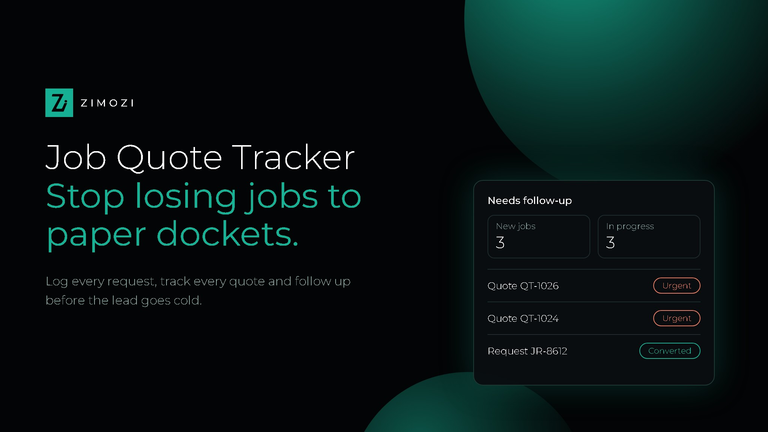
Consider an illustrative quote-preparation agent for a service business. It receives a request, identifies the customer and job type, retrieves approved pricing and asks for missing information. It then prepares a draft in the existing quotation system for an authorised person to approve.
A proposed job-reporting assistant might gather completion records, flag missing evidence and draft a customer update. It should distinguish confirmed facts from incomplete records and avoid inventing work that was never recorded.
These are design examples, not Zimozi client results. Their usefulness depends on the source data, available integrations and the people responsible for review.
Keep consequential actions behind explicit authority. A model-generated recommendation should not itself grant permission to change prices, send a commitment or update a financial record. Tool permissions, validation and approval belong in the surrounding application.
See offsetting rising costs by automating busywork for the broader operational case.
Define what you own
Ownership should be documented in the delivery agreement and demonstrated through a usable handover.
Specify rights to the custom application source, workflow configuration, prompts, evaluation cases and documentation. Identify the accounts holding infrastructure and data, and who can deploy, export, modify and support the system.
Distinguish that application from its dependencies. An agent using a commercial model API does not give you ownership of the provider’s model. A self-hosted model remains subject to its licence. Third-party libraries, connectors and existing platforms also retain their applicable terms.
A practical handover includes reproducible deployment instructions, dependency and licence records, access documentation and a clear operating owner. Source code alone is insufficient if the system can only run through undocumented vendor accounts.
Design for reasonable model portability where it matters. Keep model access separate from business logic and maintain evaluation cases for a proposed replacement. A model swap still needs testing because output quality and tool behaviour can change.
Compare the complete cost
A custom build can remove a recurring application subscription, while model execution and operations may still carry continuing costs.
| Cost | Generic AI product | Custom agent |
|---|---|---|
| Initial work | Setup, training and integration | Workflow design, development, integration and validation |
| Application fee | Product subscription or usage tier | Depends on the agreed build and licensing terms |
| Model execution | Included, capped or charged separately | API usage or self-hosted inference costs |
| Operations | Vendor platform plus your administration | Hosting, monitoring, backups, security and support |
| Change | Within the vendor’s roadmap and configuration | Requires your own maintenance and development capacity |
Compare costs over the same period and at the same workload. Include human review, retries, rejected outputs and integration failures. The useful metric is cost per correctly completed business task, not token price alone.
Self-hosting can improve control for suitable workloads, but it does not eliminate compute, energy, infrastructure or engineering costs. A managed API can be economical when volume is modest. Choose using observed demand and your data-handling requirements.
Before retiring a subscription, confirm that the replacement covers the required workflow and that data can be exported. Avoid paying for both indefinitely because migration never reaches completion.
Right-size the model and the autonomy
Use the least complex approach that meets the workflow’s quality and operating requirements.
Apply deterministic code to calculations, required fields and exact business rules. Use a model where interpretation or language generation adds value. Retrieve only authorised, relevant information instead of sending an entire document library on every request.
Route simpler tasks through a suitable smaller model when testing supports that choice. Reserve more capable models for cases that need them. Measure the effect on accuracy, latency, review effort and total task cost before adopting the change.
Set limits on agent steps, tool calls and retries. Preserve an audit trail and stop when required information is missing. Repeated model calls cannot repair absent permissions or an unavailable authoritative record.
Build a failure path as carefully as the happy path. A model outage should leave the underlying business record usable and eligible tasks available for manual completion. See disaster recovery in the AI era.
Start with one measurable workflow
Choose a frequent task with accessible data, a clear owner and an outcome you can evaluate.
Record the current handling time, cost, correction rate and approval effort. Define acceptable outputs and representative exceptions before implementation.
Release first in draft or review mode. Test wrong customer matches, outdated documents, missing permissions, unavailable tools and instructions embedded in untrusted input. Enforce authorisation outside the model and preserve human review where required.
Measure correct completions, interventions, errors and the resources consumed. Separate reclaimed capacity from cash costs removed. Expand only when the evidence supports the next workflow.
The initial scope should cover integration, evaluation, security, handover and an operating plan. No universal build price or delivery timeline can account for every business’s data and system constraints.
Common mistakes
- Buying another AI tool before identifying the operational task it will improve.
- Calling retrieval “training” without explaining how the system uses company data.
- Assuming custom-agent ownership includes a third-party foundation model.
- Promising no recurring cost while using paid APIs or hosted infrastructure.
- Letting the model decide its own permissions or approval authority.
- Measuring impressive answers instead of correctly completed tasks.
- Replacing subscriptions without a migration and maintenance plan.
FAQ
Does every business need a custom AI agent?
No. A configured existing product or simple automation may be sufficient. A custom agent is worth evaluating when company-specific rules and integrations create value that a generic tool cannot provide economically.
Must we train a model from scratch?
Usually the agent can use an existing model with approved information, examples and tools. New foundation-model training is a separate undertaking. Fine-tuning is an option to evaluate for a demonstrated need, not the default definition of custom AI.
Can we own the agent without paying a subscription?
An agreement can provide rights to the custom application without a recurring Zimozi application subscription. Model licences, API usage, infrastructure, maintenance and support remain separate items to establish in the scope.
Build AI around your daily operations
Let Zimozi build a custom AI agent tailored to the way your business works: your records, your workflow and your approval boundaries.
Bring one repetitive task and the systems involved. We can scope a focused build with agreed application ownership and no recurring Zimozi application subscription fee, while making model usage, hosting, maintenance and any third-party charges explicit before you commit.
The goal is yours to operate and maintain: a useful business application with a clear handover, rather than another generic AI seat that leaves the busywork unchanged.