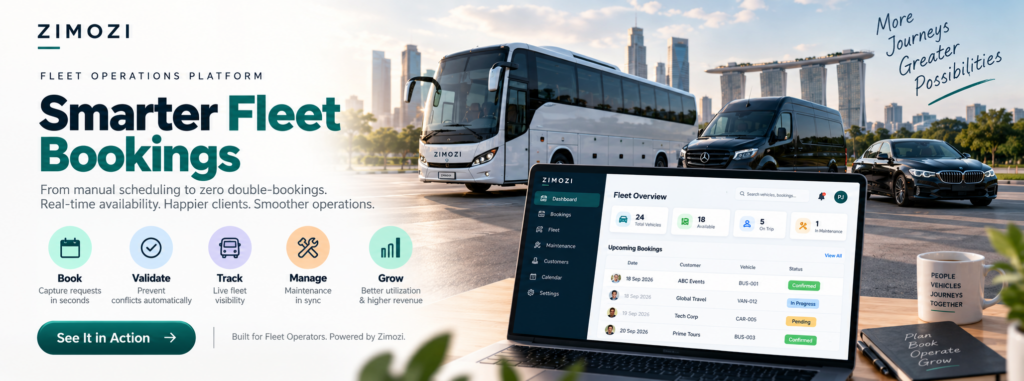
A customer calls a commercial van or bus rental company with an urgent job. The dispatcher quickly checks an Excel file, skims a WhatsApp chat group, checks a desk calendar, and attempts to remember an earlier conversation with the workshop technician.
This fragmented workflow is how many operators still manage transport assets. The core bottleneck is rarely a shortage of vehicles. It stems from the fact that no single operational dashboard reflects whether an asset is free, booked, or undergoing maintenance at the exact moment a booking is taken.
Without real-time validation, fleet double booking becomes an inevitable operational failure. Spreadsheets cannot evaluate moving schedules automatically. When dispatch teams try to hold overlapping dates in memory, conflicts slip through, leading to unfulfilled client promises, disrupted routes, and lost contracts.
What Causes Fleet Double Booking in Rental Operations?
Fleet double booking occurs when two confirmed jobs overlap on the same vehicle asset. The breakdown happens because availability is a calculated state that shifts continuously across multiple non-integrated channels.
- Fragmented data silos: Vehicle statuses sit in Google Sheets, job dates are recorded in personal calendars, and client quotes are scattered across messaging threads.
- Lack of constraint validation: Spreadsheets accept overlapping date entries without triggering an automated error or warning.
- Disconnected workshop schedules: When a technician pulls a bus in for an emergency brake repair, that maintenance window is rarely updated across the booking spreadsheet instantly.
- Multiple dispatchers: When two sales reps take phone bookings simultaneously, both can easily assign the same vehicle before either updates the shared log.
Why Spreadsheets and Chat Groups Fail Growing Fleets
Manual tools perform well for fleets with five or fewer vehicles managed by a single individual. As a fleet expands beyond fifteen assets, manual oversight breaks down.
| Operational Feature | Spreadsheets & Chat Groups | Dedicated Fleet Availability Tracking Software |
|---|---|---|
| Overlap Detection | Manual inspection (High error rate) | Automated hard validation rules |
| Maintenance Sync | Disconnected notes or technician memory | Automatically blocks maintenance windows |
| Multi-User Sync | Prone to overwrite conflicts and delays | Real-time centralized availability engine |
| Search Speed | Minutes spent cross-referencing sheets | Millisecond lookup by date, type, and capacity |
| Audit Trail | Untracked edits and deleted rows | Complete timestamped booking logs |
A spreadsheet is merely a ledger. It cannot run relational logic to reject a conflicting reservation. If your operations rely on staff remembering every constraint, human error will inevitably produce scheduling clashes.
How Real-Time Fleet Availability Tracking Software Eliminates Overlaps
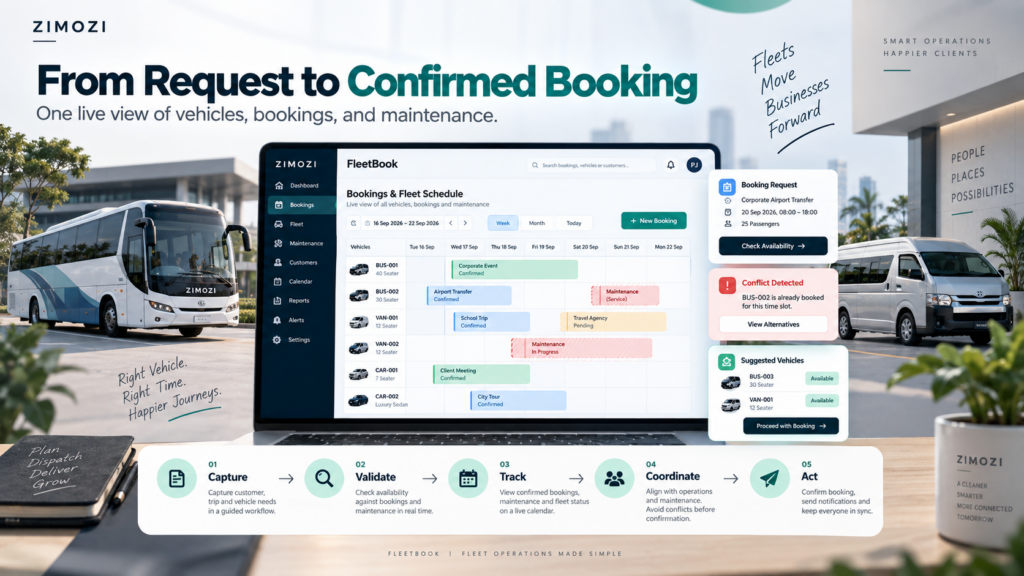
Dedicated fleet availability tracking software establishes a single source of truth for bookings, vehicles, and maintenance windows.
Instead of relying on human recall, the system calculates availability using standard interval scheduling algorithms where a conflict occurs whenever a new requested start precedes an existing booking end, and the new requested end exceeds the existing booking start.
If this condition evaluates to true for an existing charter or workshop job, the engine prevents the dispatch team from confirming the reservation.
6 Ways AI and Automation Streamline Fleet Management
Artificial intelligence does not replace the core mathematical conflict engine. Rather, modern AI fleet management enhances the workflows surrounding data intake and vehicle allocation.
- Extracting Unstructured Enquiries: Natural language processing parses messy email threads and chat requests into structured dates, passenger numbers, and vehicle specifications.
- Predictive Maintenance Scheduling: Machine learning models analyze real-time diagnostics via commercial vehicle telematics standards and odometer thresholds to schedule inspections during historically low-demand timeframes.
- Smart Vehicle Assignment: When ten identical vans are free, AI models rank which unit should be assigned based on balanced mileage distribution and wear metrics.
- Proactive Clash Alerts: Automated listeners monitor potential delays on active routes and flag vehicles that risk missing upcoming scheduled pickups.
- Dynamic Buffer Calculation: Machine learning adjusts turnaround buffers based on regional traffic density and cleaning requirements between trips.
- Executive Operations Summaries: Natural language summaries report asset utilization trends, upcoming bottlenecks, and idle inventory directly to fleet owners.
Is Fleet Double Booking Draining Your Business? (Assessment Checklist)
Review this checklist to determine if your operation has outgrown manual coordination:
- You operate 10 or more commercial vehicles across multiple categories.
- Two or more dispatchers or administrators accept reservations independently.
- Scheduled maintenance is logged in a separate notebook, sheet, or calendar.
- Staff take more than two minutes to verify whether an asset is free for a client.
- Your company experienced a double-booking incident or near-miss within the last 90 days.
If you checked three or more items, continuing to manage operations via disconnected spreadsheets presents a recurring risk to your operating margins and client retention.
Frequently Asked Questions (FAQ)
What is the primary cause of fleet double booking?
Fleet double booking is primarily caused by decentralized scheduling records. When customer bookings, vehicle availability, and maintenance logs are managed across isolated spreadsheets and chat messages, staff cannot see real-time conflicts before making a verbal or written commitment.
How does fleet availability tracking software prevent overlapping reservations?
The software uses automated conflict detection logic. Every time a new reservation is initiated, the engine checks the requested start and finish times against all existing bookings and maintenance blocks for that vehicle. Any overlap triggers an automated stop that prevents confirmation.
Can artificial intelligence stop double-booking on its own?
No. Preventing overlapping reservations requires rigid, rule-based logic rather than predictive AI. Machine learning should instead be used to structure customer enquiries, calculate turnaround buffers, and recommend suitable vehicle models once the underlying availability engine validates that the asset is truly open.
How should vehicle maintenance be integrated into a fleet booking calendar?
Maintenance must share the exact database used by dispatchers. When an asset is marked for scheduled maintenance or unscheduled workshop repairs, the software must block those calendar dates from the booking view, ensuring unroadworthy vehicles cannot be reserved.
What fleet size justifies upgrading from spreadsheets to dedicated software?
Operators with more than ten vehicles or multiple staff members handling bookings typically outgrow spreadsheets. If verifying vehicle availability takes longer than a few seconds, upgrading to dedicated software prevents costly dispatch errors and improves response times.
Modernize Your Dispatch Operations
Relying on memory, spreadsheets, and chat threads introduces unnecessary coordination risk into growing transport businesses. Automated availability tracking eliminates double-booking errors at the source by evaluating schedules against rigid business rules.
Fleet managers looking to safeguard customer relationships can transition away from manual data entry and deploy unified availability tracking tools designed for modern commercial fleets.
Learn more about our fleet management services to completely prevent fleet double booking. Our specialized tools help you eliminate every single fleet double booking incident efficiently.
Learn more about custom engineering: Zimozi Solutions