When a customer calls to ask whether their four pallets were dispatched, who currently holds physical custody, and whether six incoming pallets can be accommodated on Monday, dispatchers frequently cannot provide an instant answer.
Using a dedicated Delivery Job and Storage Tracker helps teams resolve these status questions instantly.
A reliable Delivery Job and Storage Tracker streamlines daily warehouse workflows significantly.
Answering routine customer questions often requires checking a dry-erase whiteboard, calling drivers on the road, sifting through clipboards of paper delivery orders, and walking the warehouse floor to inspect empty bays. If the driver does not answer the call, the coordinator can only promise to check and call back later.
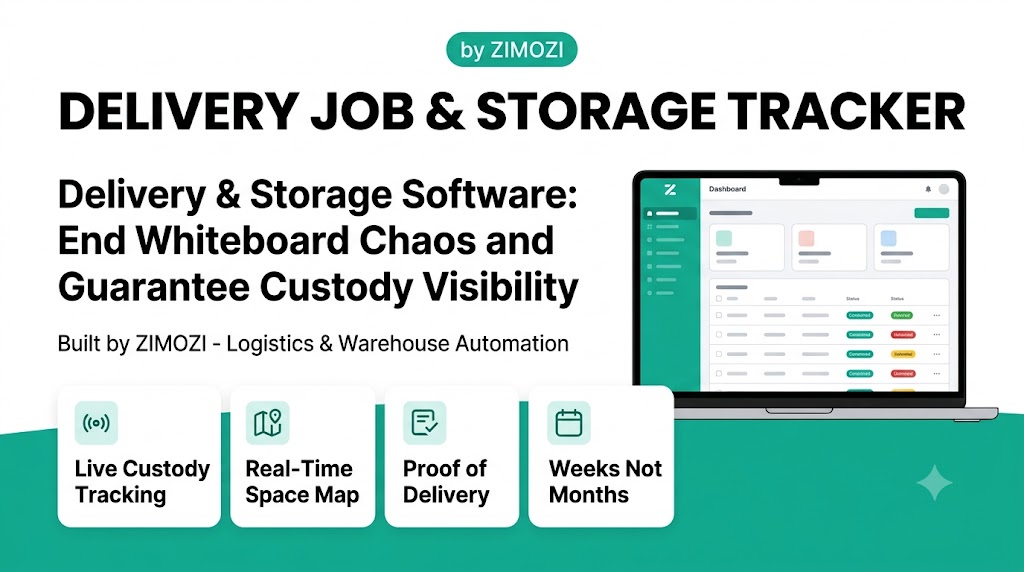
The Delivery Job and Storage Tracker developed by Zimozi provides a centralized operational web tool built specifically for growing logistics and storage operators worldwide. By unifying consignment job orders, chain of custody handoffs, and visual warehouse space mapping into a single workspace, it eliminates misplaced dockets and unbilled storage space. Learn more about our custom business workflows across Zimozi Software Solutions.
Why Tracking Deliveries and Warehouse Space on Whiteboards and Paper Fails
Managing freight handoffs and warehouse square footage through clipboards and phone calls works for very small operations, but adopting a Delivery Job and Storage Tracker improves overall efficiency.
- Unrecorded chain of custody handoffs: Freight moves from the warehouse to in-house drivers, external freight carriers, and receiving docks, yet these custody changes exist only in phone conversations and personal memory.
- Missing proof of delivery (POD): Paper delivery dockets sit on vehicle dashboards for days, leaving operators vulnerable to customer billing disputes. According to supply chain documentation standards outlined by the Council of Supply Chain Management Professionals, maintaining verifiable chain-of-custody records is vital to preventing invoice bottlenecks.
- Unbilled warehouse storage: Storage agreements expire quietly, allowing customer pallets to occupy floor space for months past their initial term without recurring billing.
- Inaccurate bay capacity estimates: Dispatchers guess at available capacity, leading them to either quote nonexistent space or leave billable racks empty.
- Office switchboard bottlenecks: Coordinators spend hours acting as phone relays between customers and field drivers instead of operating from an authoritative system.
- Single point of failure: Operational status resides inside one dispatcher’s head, causing office coordination to degrade the moment that employee takes leave.
This administrative friction affects logistics providers globally. Implementing a Delivery Job and Storage Tracker solves these systemic challenges.
Core Capabilities of the Delivery Job and Storage Tracker
The platform establishes a connected workflow that monitors delivery movements, custody transfers, and storage allocations. Every feature in this Delivery Job and Storage Tracker works without unnecessary enterprise complexity:
| Core Operational Feature | Logistics and Storage Impact |
| Comprehensive Job Management | Tracks delivery, collection, moving, storage intake, and transfer jobs across clear stages from Booked to Closed. |
| Chain of Custody Tracking | Records every transfer between dispatch, internal fleets, 3PL partners, and end receivers as a timestamped event. |
| Handoff Exception Flagging | Flags unconfirmed transfers and missing delivery receipts to catch delivery disputes before they escalate. |
| Live Visual Space Map | Displays warehouse bays, pallet racks, and storage slots marked clearly as free, reserved, or occupied. |
| Automated Occupancy Calculation | Computes real-time capacity directly from allocated storage slots rather than relying on manual headcounts. |
| Agreement Expiry Alerts | Highlights approaching and expired storage agreements on the main screen to prevent unbilled warehouse rent. |
The Daily Operational Flow for Logistics Coordinators
The Delivery Job and Storage Tracker gives office dispatchers an integrated routine to manage dispatches and storage spaces from a single terminal:
- Book Consignment and Storage Orders: The coordinator creates the job ticket with customer details, cargo manifests, and service schedules, selecting delivery, collection, or storage job types.
- Assign Storage Bays Dynamically: When cargo arrives for short-term holding, staff allocate available bays on the live map, updating facility capacity immediately.
- Log Custody Handoffs: As goods transfer from the staging bay to the delivery vehicle or a third-party carrier partner, dispatch logs the dated handoff event to create an auditable timeline.
- Record Delivery Proof: Once delivery completes, the coordinator links confirmation details to the job record, closing out the run and releasing the ticket for prompt invoicing.
- Review Storage Agreement Deadlines: The coordinator reviews the dashboard to identify storage accounts approaching renewal dates, preventing unbilled overstays.
- Answer Inquiries with Single Search: When a client calls to check shipment status or warehouse availability, staff search by customer name, job reference, bay slot, or vehicle identifier to verify answers instantly.
Why Focused Coordination Software Beats Bulky Warehouse Management Systems
Many small-to-medium logistics companies attempt to implement massive warehouse management systems (WMS) or complex enterprise fleet suites, only to abandon them due to steep learning curves and excessive overhead. As highlighted by Investopedia’s overview of supply chain management, lean operations often perform best by eliminating unnecessary system complexity and focusing directly on flow visibility.
The Delivery Job and Storage Tracker is purposefully scoped for lean office teams who manage both delivery dispatches and local storage under one roof. To keep adoption fast and frictionless, non-essential modules are intentionally omitted from the core version:
- No dedicated driver mobile app requirements.
- No live GPS vehicle tracking or moving map dots.
- No complex billing, quotation, or payment processing engines.
- No SKU-level retail inventory control or item barcode scanners.
- No multi-facility networks or complex courier API integrations.
By focusing strictly on custody handoffs, job progress, and visual space occupancy, the software gives coordinators a reliable operational command center that functions smoothly from day one.
Frequently Asked Questions (FAQ)
What is the Delivery Job and Storage Tracker?
The Delivery Job and Storage Tracker is an operational web application built by Zimozi that gives small-to-medium logistics providers worldwide a unified screen to monitor consignment statuses, verify chain of custody transfers, and manage warehouse bay occupancy.
How does the system prevent unbilled warehouse storage?
The platform tracks contract durations for stored items and flags expiring or expired agreements directly on the coordinator dashboard, preventing customer goods from occupying billable floor space without active invoicing.
Why is recording custody handoffs important for logistics SMEs?
Recording each transfer as a dated event between the warehouse, fleet drivers, partner carriers, and final receivers builds an auditable chain of custody, helping operators resolve client claims quickly without searching for lost paper dockets.
Who is this logistics and storage software designed for?
The platform is designed for independent moving and relocation businesses, small third-party logistics (3PL) providers, local courier fleets holding transit cargo, and commercial document/asset storage operators offering collection and delivery services.
Does the tracker require GPS hardware or driver smartphone apps?
No. The core system functions as an office-based coordination board that records status milestones and custody events entered by staff, eliminating the expense and technical maintenance of dedicated driver mobile apps and vehicle GPS hardware.