Industrial equipment suppliers worldwide face major bottlenecks in industrial equipment servicing when managing machinery such as compressors, forklifts, lathes, generators, and welding sets. Effective industrial equipment servicing requires immediate access to machine service logs and technician schedules.
When a client calls asking whether a compressor at their manufacturing facility is still covered under contract or where an assigned technician is, front-office coordinators often cannot provide an immediate answer. Office staff must pause the call, track down paper job dockets, check a colleague’s personal spreadsheet, or telephone technicians working in the field. If the employee who maintains the schedule is out of the office, the customer is left waiting for a callback.
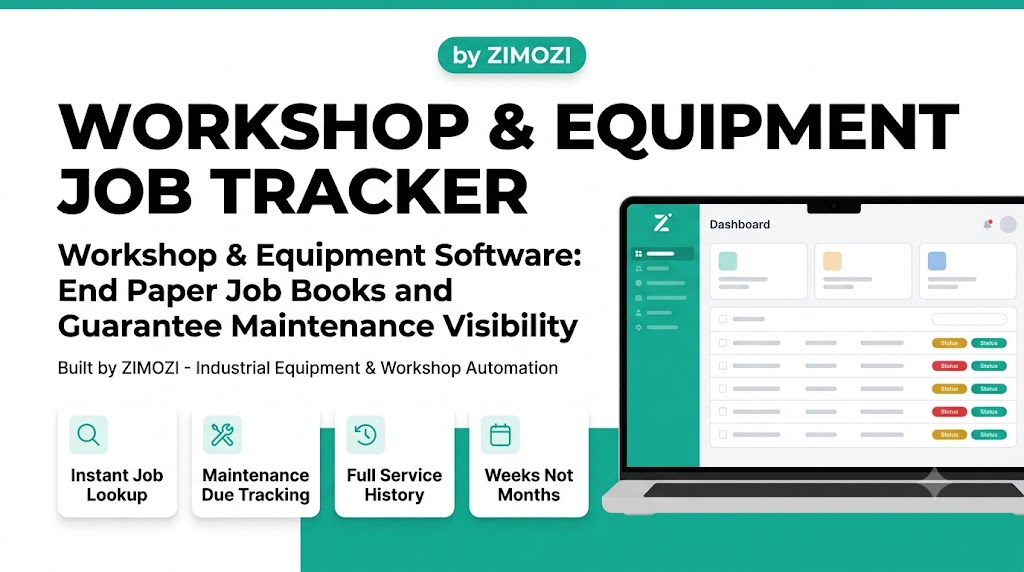
The Workshop and Equipment Job Tracker by Zimozi provides a centralized web application engineered specifically for SME equipment suppliers, distributors, and industrial service workshops globally. By maintaining one searchable record organized by customer and individual machine, it allows office coordinators to verify repair statuses, warranty terms, and maintenance schedules while the customer is still on the line.
Why Managing Industrial Equipment Servicing on Paper Creates Costly Delays
Operating an equipment maintenance department using paper job books, whiteboards, and localized spreadsheets works during quiet periods with only a few daily work orders. As concurrent jobs and machine fleets expand across industrial zones and multi-site client facilities, manual tracking breaks down:
- Unnoticed maintenance lapses: Preventive maintenance deadlines sit on wall calendars or private spreadsheets, meaning upcoming services quietly slip until a machine breaks down on site.
- Office switchboard bottlenecks: Because office coordinators lack live visibility into job assignments, every customer update requires telephoning the technician on site.
- Service history filed by date instead of asset: Work orders are typically archived chronologically in paper binders or dated folders rather than indexed by machine serial number, making it tedious to determine when a specific component or filter was last replaced.
- Unclear warranty and contract coverage: Without instant contract visibility, teams guess at coverage, leading to billing for covered repairs or providing billable work for free.
- Fragile operational continuity: Operational knowledge is concentrated in one person’s head, causing workshop dispatch and coordination to stall whenever that individual takes leave.
This is a structural challenge across the machinery distribution and service sector worldwide. Thousands of industrial wholesalers, plant hire firms, and aftermarket service providers struggle with the exact same friction: when service tracking depends on disconnected files, busy service weeks inevitably lead to missed SLA commitments, unexpected downtime, and damaged client relationships.
According to maintenance management benchmarks from Reliable Plant, structured preventive maintenance can reduce unplanned downtime by over 30% compared to reactive repair workflows.
Core Capabilities of the Workshop and Equipment Job Tracker
By centralizing these core features, workshops transform reactive repairs into planned, predictable industrial equipment servicing.
The platform focuses on the essential operational loop needed to manage client machinery, scheduled preventive servicing, and workshop repairs:
| Operational Feature | Workshop and Service Impact |
| Asset-Centric Job Logging | Records work orders against the specific customer and machine, capturing reported faults, priority levels, site addresses, assigned technicians, and work notes. |
| Maintenance Due-Date Monitoring | Identifies equipment requiring scheduled servicing through structured Overdue, Due-This-Week, and Due-This-Month dashboard views. |
| Transparent Job Status Lifecycle | Tracks service orders through distinct milestones from New through to Completed without requiring phone check-ins. |
| Warranty and Contract Visibility | Links active maintenance contracts, service-level agreements (SLAs), and warranty coverage windows directly to the machine profile. |
| Single Search History Retrieval | Allows staff to pull up an entire customer account or machine history instantly using a single search bar. |
The Daily Operational Flow for Workshop Coordinators
The Workshop and Equipment Job Tracker streamlines front-office administration into a reliable routine:
- Review Due and Overdue Servicing: The coordinator opens the maintenance dashboard each morning to check which industrial assets require inspection during the current week or month.
- Convert Due Maintenance into Scheduled Jobs: With one click, approaching preventive service intervals are converted into active work orders and assigned to available technicians.
- Log Inbound Repair Requests: When an urgent fault call arrives, staff record the equipment serial number, customer site location, problem description, and required priority level directly into the system.
- Verify Contract and Warranty Terms: Staff check whether the asset has valid warranty coverage or an active service contract on screen, ensuring accurate billing from the start.
- Update Work Progress Through the Lifecycle: As jobs move from New to In Progress and Completed, status updates keep the office aligned on open work orders across all client sites.
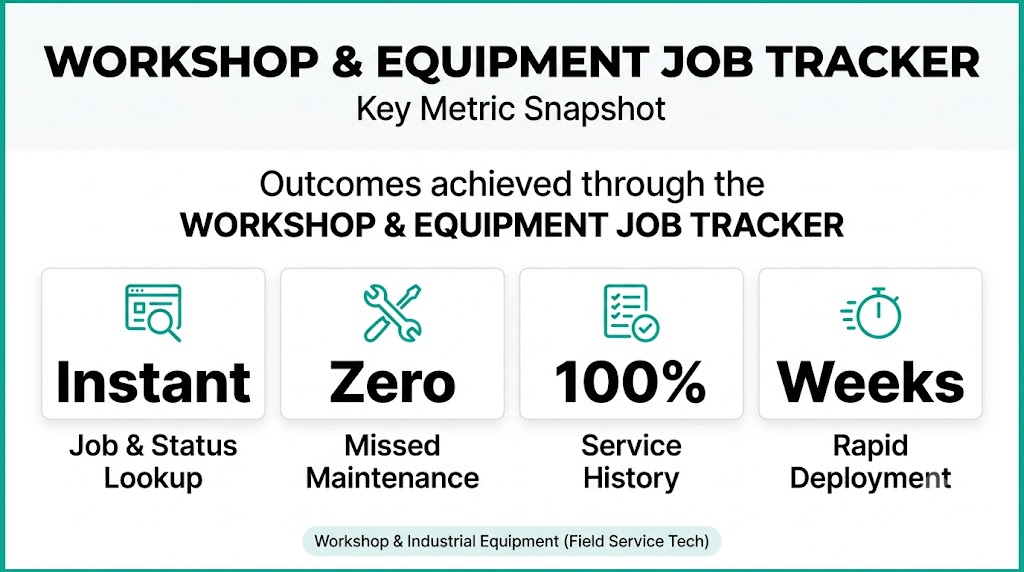
- Answer Inquiries Immediately on the Phone: When a plant or facility manager calls for an update, the coordinator searches the machine record to confirm the technician assignment, job status, and past service logs in seconds.
Why Focused Tracking Tools Outperform Heavy Enterprise ERPs
Small and mid-sized industrial suppliers—typically employing between 5 and 50 staff with 2 to 15 field and workshop technicians—often struggle with traditional enterprise resource planning (ERP) suites. Enterprise systems are expensive, demand months of complex implementation, and include dozens of bloated modules that slow down daily dispatch operations. Most off-the-shelf software packages fail because they overcomplicate routine industrial equipment servicing with unnecessary administrative layers
The Workshop and Equipment Job Tracker is intentionally scoped for office coordinators to maintain rapid adoption. To eliminate unnecessary friction, non-essential enterprise layers are excluded:
- No complicated field technician apps that require extensive device management.
- No bulky payment gateways or complex accounting modules that duplicate your existing software.
- No convoluted warehouse ledgers that slow down simple job entries.
- No multi-tenant architectural overhead or complicated customer-facing portals.
By keeping the platform centered on job logging, preventive maintenance schedules, asset history, and contract validation, the software provides an immediate operational upgrade that requires minimal onboarding.
Frequently Asked Questions (FAQ)
What is the Workshop and Equipment Job Tracker?
The Workshop and Equipment Job Tracker is a streamlined operational web platform built by Zimozi that gives industrial equipment suppliers, machinery dealers, and service workshops a single searchable record per customer and machine to manage repairs, maintenance due dates, and service histories.
How does the system prevent scheduled maintenance from being missed?
The application tracks recurring maintenance dates automatically and groups upcoming visits into Overdue, Due-This-Week, and Due-This-Month dashboard views, allowing coordinators to convert due dates into scheduled jobs before machinery breaks down on site.
Why is organizing service history by machine better than filing by date?
Filing service history by specific machine allows coordinators to review past repairs, component replacements, and previous technician notes instantly during customer calls, rather than digging through dated paper job dockets or unlinked folders.
Who is this equipment maintenance tracker designed for?
The platform is designed specifically for SME industrial equipment suppliers, plant hire companies, machinery distributors, and workshop service providers handling equipment such as compressors, forklifts, machine tools, generators, and welding sets. It is tailored for any business providing routine industrial equipment servicing across customer facilities.
Does the software manage parts inventory or mobile technician dispatching?
No. The core version focuses strictly on front-office job coordination, asset history, contract tracking, and maintenance schedules, intentionally omitting complex parts inventory ledgers, mobile apps, and billing modules to remain fast, focused, and easy to use.