A commercial landscaping company does not handle only one-off projects. The vast majority of its steady revenue comes from recurring grounds-maintenance contracts that operate on weekly, bi-weekly, monthly, or customized seasonal cycles. Every active agreement requires the right service to be delivered on the exact scheduled date with an appropriately assigned maintenance crew. A Job and Crew Scheduling Tool helps commercial landscaping companies worldwide efficiently manage these recurring maintenance schedules, coordinate crew assignments, and ensure consistent service delivery.
In many small and mid-sized landscaping companies globally, recurring appointments are tracked using paper wall calendars, desktop spreadsheets, personal pocket diaries, or scattered messaging threads like WhatsApp and SMS. While a business owner knows that an HOA community, retail park, or corporate campus requires regular groundskeeping, confirming the next appointment requires checking when the last service occurred and manually calculating the next due date.
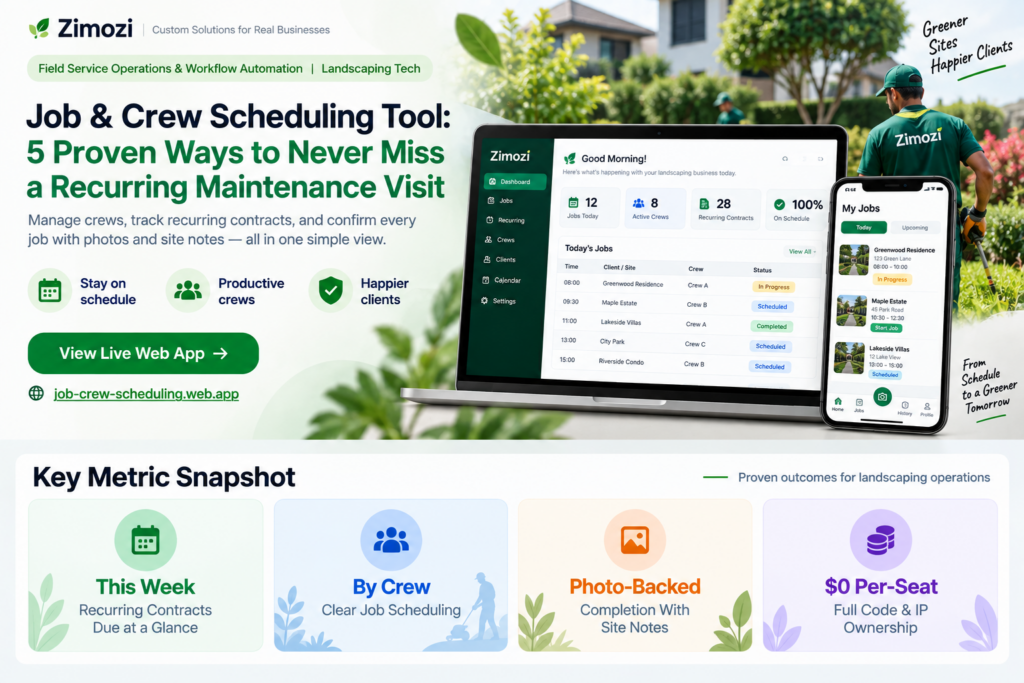
The Job and Crew Scheduling Tool developed by Zimozi provides an operational web platform designed specifically for growing landscaping contractors, grounds maintenance operators, and lawn-care businesses.
Why Paper Calendars and Chat Messages Fail for Recurring Landscaping
A physical wall calendar can record a date, but it cannot maintain the operational history required to manage multi-site landscaping contracts across different regions and seasons. Relying on manual diaries and instant messaging apps creates recurring operational failures across field teams:
- Missed recurring service visits: Owners must mentally track contract frequencies and count forward from previous visits, meaning one missed calendar update causes a client appointment to be overlooked.
- Disconnection between contracts and calendars: A customer may hold an active maintenance agreement, yet the daily operational schedule fails to reflect the upcoming required visit.
- Crew assignment confusion: Jobs listed on a whiteboard or calendar often lack clear ownership, leaving crew assignments buried in messaging threads and causing overlapping or double-booked schedules.
- Lost site context and access instructions: Gate access codes, specific plant care guidelines, irrigation notes, and previous site photos remain trapped in personal chat histories instead of attaching to the job ticket.
- Delayed completion updates: Field crews and arborists complete the site visit, but the main office continues to view the job as outstanding until someone calls or texts.
- Lack of operational visibility: Business owners cannot assess the week as a whole, requiring them to cross-reference multiple sheets to see what is due, what is in progress, and what has been finished.
Core Capabilities of the Job and Crew Scheduling Tool
The system replaces manual diary entries and message threads with an integrated operational loop designed around recurring maintenance services:
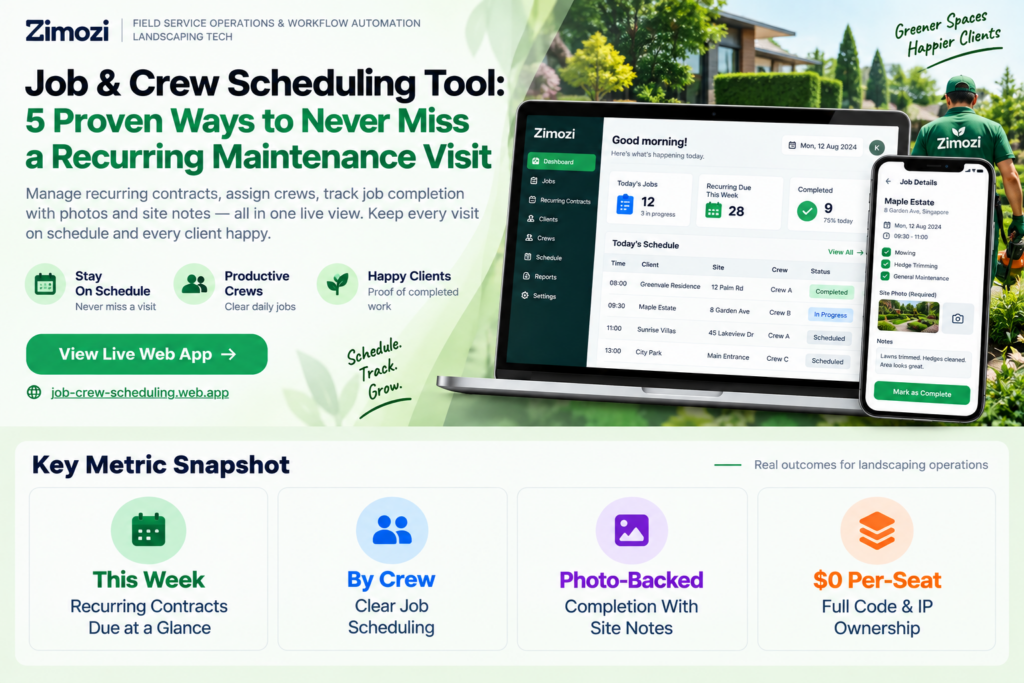
| Operational Feature | Landscaping Business Function |
| Recurring Contract Tracking | Stores maintenance frequencies and automatically calculates upcoming visit deadlines for every active client contract across any service cadence. |
| Due-This-Week View | Aggregates all recurring maintenance visits due during the current week onto a single management dashboard. |
| Job Scheduling by Crew | Allocates field teams directly to scheduled visits, establishing unambiguous ownership for every client site. |
| Site Notes and Photos | Attaches gate codes, special instructions, historical notes, and site photos directly to the specific job record. |
| Digital Completion Marking | Allows field crews to submit completion updates and on-site proof-of-work photos directly from their mobile devices. |
The Weekly Operational Workflow for Landscaping Managers
The platform transitions landscaping management from manual recall to a clear, recurring service cycle:
- Record the Service Agreement: The manager logs the client site, agreed maintenance cadence (such as weekly, bi-weekly, or monthly), and the initial service date into the system.
- Review the Due-This-Week Screen: At the start of each work week, the manager opens the centralized dashboard to review approaching maintenance visits across all client accounts.
- Schedule and Dispatch Crews: The coordinator confirms specific service dates and assigns the appropriate maintenance crew, locking assignment details directly to the job ticket.
- Access Site Context on Location: Before starting on-site work, crew leaders open the job file to review gate access instructions, client preferences, and past inspection photos.
- Complete Work and Upload Evidence: After trimming, mowing, and grounds maintenance are complete, the team uploads finished site photos and marks the job complete.
- Verify Progress from the Office: The manager’s dashboard updates in real time, displaying completed accounts without requiring individual follow-up calls.
- Advance to the Next Service Cycle: The software advances the recurring contract to its subsequent due date, ensuring long-term maintenance contracts never disappear from view.
Why Focused Operational Tools Outperform Heavy Landscape Software
Many grounds-maintenance businesses attempt to implement massive enterprise resource planning (ERP) suites only to abandon them due to complexity, high subscription costs, and steep learning curves. According to industry insights from the National Association of Landscape Professionals, operational efficiency and simple field scheduling remain the primary drivers of client retention for recurring service contractors.
The Job and Crew Scheduling Tool focuses strictly on the essential operational bottleneck: connecting ongoing contracts with scheduled visits, assigned crews, and verified field completion. Non-essential enterprise features such as complex customer self-service portals, route optimization, automated invoicing, payroll calculations, equipment depreciation, chemical application logs, and GPS fleet tracking are kept out of the core workflow to maintain operational speed.
By focusing directly on contract due dates, dispatch visibility, and completion evidence, the tool delivers an interface that operations managers and field workers anywhere in the world can adopt immediately without formal training sessions.
Frequently Asked Questions (FAQ)
What is the Job and Crew Scheduling Tool?
The Job and Crew Scheduling Tool is an operational web application built by Zimozi that helps commercial landscaping, lawn care, and grounds-maintenance companies manage recurring maintenance contracts, schedule field crews, and verify job completion with site photos.
How does the tool prevent missed visits for recurring maintenance contracts?
The system calculates upcoming service dates based on contract frequencies (weekly, bi-weekly, monthly, or customized cycles) and displays them automatically inside a dedicated Due-This-Week dashboard, preventing visits from being overlooked on paper calendars or personal spreadsheets.
Can field crews access site instructions and past photos on mobile devices?
Yes. Specific gate access codes, property notes, and past photos stay attached to the job record, allowing crew members to review necessary context directly on their mobile screens before starting work.
Who is this scheduling software designed for?
The platform is designed for commercial landscaping contractors, grounds maintenance operators, lawn-care teams, corporate facility groundskeepers, and estate maintenance companies managing recurring service schedules across multiple properties.
Does the application handle client billing or payroll processing?
No. The core system focuses exclusively on the operational schedule, crew assignments, site context, and completion tracking, avoiding complex billing or payroll integrations to keep the software lean and easy to operate.