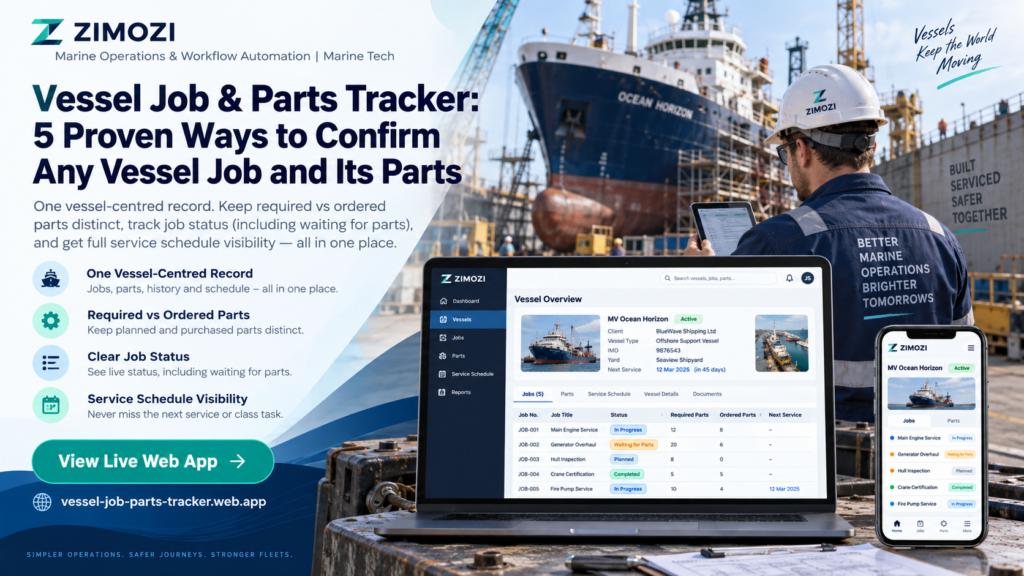
The Vessel Job and Parts Tracker helps marine supply, ship repair, and maritime contracting businesses manage demanding operational schedules across global ports, shipyards, and service timelines. Every vessel maintenance job depends on technical components, spare parts, and equipment being identified, sourced, and staged before shipyard technicians can begin work.
In many small-to-midsize maritime supply firms, job details remain scattered across paper work orders, localized desktop spreadsheets, and disjointed messaging apps. The shipyard superintendent holds one version of a work scope, the supplier’s operations office maintains another, and the procurement coordinator tracks critical parts on a disconnected personal spreadsheet.
When a shipowner, vessel manager, or superintendent requests an urgent progress update, operational teams often cannot confirm whether delays stem from on-site labor or pending part shipments.
The Vessel Job and Parts Tracker by Zimozi provides a purpose-built operational platform designed for maritime service and supply providers. By linking client accounts, yard locations, vessel profiles, required parts, procurement milestones, live repair statuses, and future service dates into one unified workspace, it eliminates cross-team guesswork and parts-related bottlenecks.
Why Traditional Tracking Breaks Down in Ship Repair and Marine Supply
Coordinating maritime parts and technical repairs without a centralized tracking system introduces severe operational blind spots that compound as vessel volume expands:
- Disconnected parts lists: A repair ticket is created in the operations hub, but the list of required technical parts remains isolated in a buyer’s email or notebook.
- Ambiguity between required and ordered states: Noting that a component is needed does not mean an order was placed, leaving field engineers waiting while parts sit unpurchased.
- Unclear root causes for vessel delays: When turnaround schedules slip, management cannot instantly determine whether the bottleneck is yard labor or delayed customs/freight clearance.
- Multi-yard confusion: Managing concurrent refits across multiple regional anchorages, drydocks, and shipyards leads to mixed-up status reports and misrouted part deliveries.
- Outdated operational records: Critical progress adjustments made during daily dock inspections fail to reach commercial and account managers, leaving client-facing teams with obsolete data.
- Isolated future maintenance schedules: Upcoming International Association of Classification Societies (IACS) class surveys, drydock intervals, and mandatory maintenance sit in personal calendars and vanish once the immediate job sheet closes.
For maritime service providers worldwide, handling complex repair schedules through fragmented chat threads and manual sheets introduces compliance risks and erodes shipowner trust. A dedicated tracker keeps vessel jobs, parts procurement, and service schedules aligned across technical and commercial teams.
Core Capabilities of the Vessel Job and Parts Tracker
Instead of forcing teams to adapt to rigid enterprise resource planning platforms, the system focuses strictly on the operational link connecting vessel jobs, parts procurement, and maintenance timelines:
| Core Operational Feature | Marine Supply & Service Function |
| Vessel Job Log by Yard and Fleet | Maps every repair and supply order to its specific vessel, client account, and shipyard/port location. |
| Required Parts Tracking | Catalogs all necessary machinery, spares, and consumables directly inside the active vessel job ticket. |
| Ordered Parts Tracking | Separates items that have been ordered from those merely identified, creating instant procurement accountability. |
| Operational Job Status | Tracks real-time work stages: Open, In Progress, Waiting for Parts, and Completed. |
| Vessel Service Scheduling | Ties upcoming survey, overhaul, and drydock dates directly to the vessel profile to secure repeat business. |
| Unified Fleet Status View | Combines live job progress, parts procurement status, and service intervals on a single dashboard for rapid customer reporting. |
The Daily Operational Workflow for Marine Supply Teams
The Vessel Job and Parts Tracker standardizes the workflow for office administrators, procurement buyers, and port engineers:
- Select Client, Yard, and Vessel: Identify the client account, port or shipyard facility, and vessel profile before opening the work order, preventing cross-yard mix-ups.
- Log the Vessel Job: Enter the technical scope of work and set the initial job stage, giving both commercial and technical teams immediate visibility.
- Record Required Parts: Log every necessary component, replacement unit, and consumable directly against the vessel ticket.
- Update Parts to Ordered Status: Once purchase orders or sourcing agreements are executed, shift items from Required to Ordered to keep delivery timelines transparent.
- Adjust Live Job Statuses: Update operational milestones as work progresses, signaling immediately when a project is Waiting for Parts.
- Maintain Vessel Service Schedules: Keep future class survey deadlines and planned overhaul windows attached to the vessel profile so upcoming maintenance isn’t forgotten after departure.
- Resolve Client Inquiries Instantly: When a fleet technical superintendent or ship manager calls for a progress report, pull up the vessel dashboard to report exact job progress and part delivery dates.
Why Focused Operational Tools Outperform Heavy Shipyard ERPs
Many marine suppliers attempt to adopt massive enterprise ERP suites only to abandon them after encountering high software fees, lengthy onboarding cycles, and bloated menus that staff avoid using.
The Vessel Job and Parts Tracker uses a lightweight, practical approach. Enterprise modules such as external purchase order dispatching, supplier EDI integrations, warehouse inventory management, customer invoicing, payroll processing, International Maritime Organization (IMO) AIS and GPS vessel tracking protocols, engineering drawing storage, and shipyard drydock management are intentionally excluded from the initial release.
By focusing strictly on linking vessel jobs, yard context, parts statuses, and service maintenance schedules, the application delivers a reliable system that shipyard coordinators and office personnel can use without extensive software training.
Frequently Asked Questions (FAQ)
What is the Vessel Job and Parts Tracker?
The Vessel Job and Parts Tracker is an operational web tool created by Zimozi that gives Singapore marine and shipbuilding suppliers a unified platform to track vessel repair jobs, shipyard locations, required parts, procurement progress, and upcoming maintenance schedules.
How does the application prevent parts-related job delays?
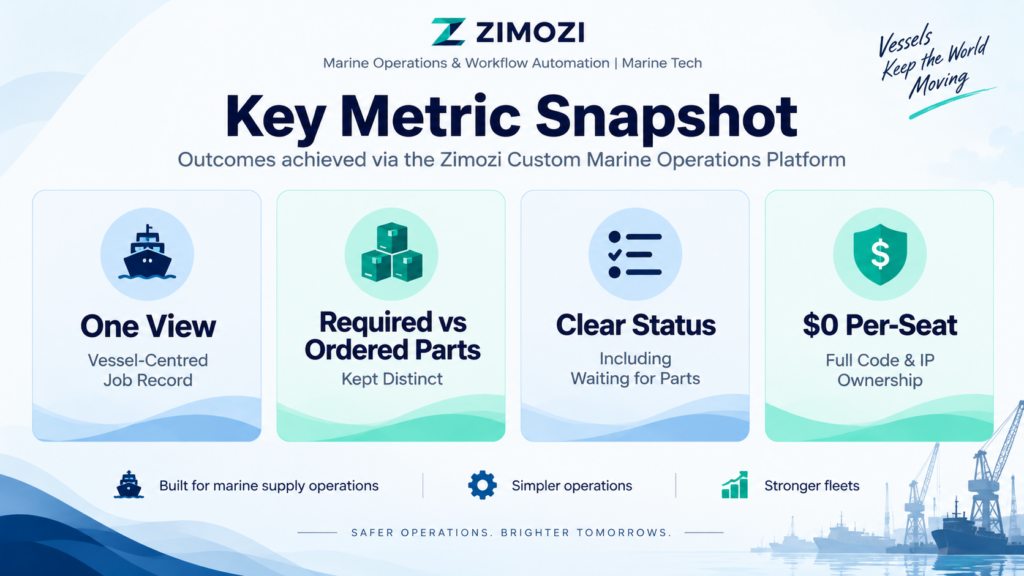
The system separates parts into explicit Required and Ordered statuses directly inside the vessel job ticket, ensuring that procurement bottlenecks are identified early and preventing unverified purchasing assumptions.
Who is this marine tracking system built for?
The platform is designed specifically for Singapore SME marine suppliers, ship repair contractors, maritime equipment distributors, and shipyard service providers handling multiple concurrent vessel jobs across different yards.
Does the application connect to external suppliers to place purchase orders automatically?
No. The core system functions as an internal operational tracker that documents whether required items have been ordered and links that progress to the vessel job, without integrating automated third-party supplier purchasing gateways.
How does tracking jobs by vessel improve customer communication?
Organizing records around the vessel allows staff to review shipyard locations, active repair stages, ordered parts, and upcoming service dates on a single screen, enabling instant and accurate answers to client status calls.